What HomeBuyer Leverage™ Measures That ChatGPT Cannot
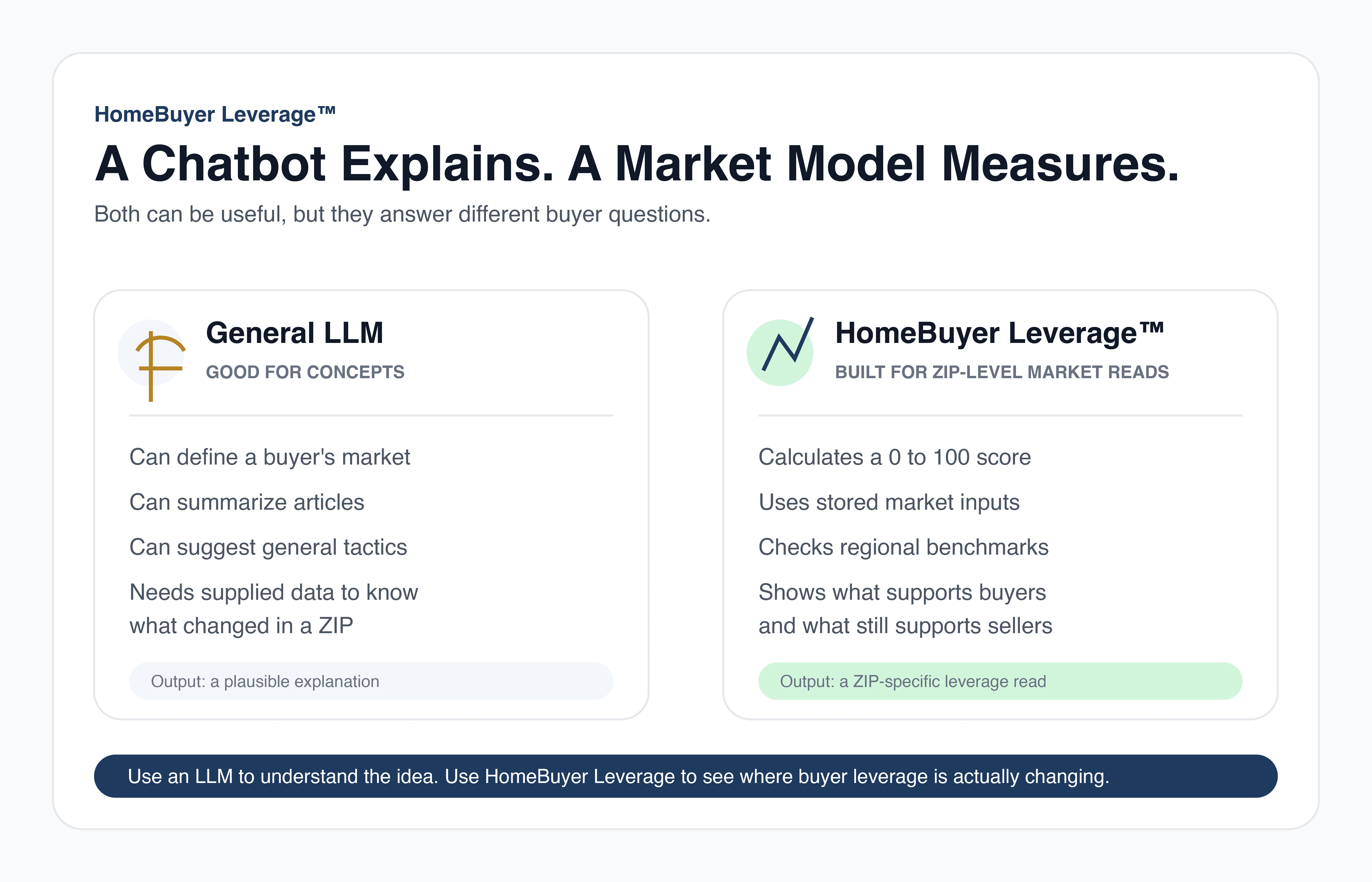
ChatGPT, Gemini, Claude, and other AI tools are useful for learning real estate concepts. They can explain what a buyer's market means, summarize articles, and suggest general negotiation ideas.
But they do not automatically know whether buyers have more leverage in your specific ZIP code right now.
HomeBuyer Leverage is built for that job. It uses stored housing, pricing, supply, demand, affordability, financing, local economy, and permit data to calculate a ZIP-level buyer leverage score and explain what is driving it.
The Practical Question Buyers Need Answered
Most buyers do not need another generic explanation of the housing market. They need a clear read on one local question:
**In this ZIP code, do current market conditions give buyers more leverage, less leverage, or a balanced negotiating position?**
That answer has to be current, local, and tied to evidence. A national housing headline will not tell you how to write an offer in one ZIP. A chatbot answer may sound confident, but unless it is connected to fresh structured data, it is still guessing from whatever context it was given.
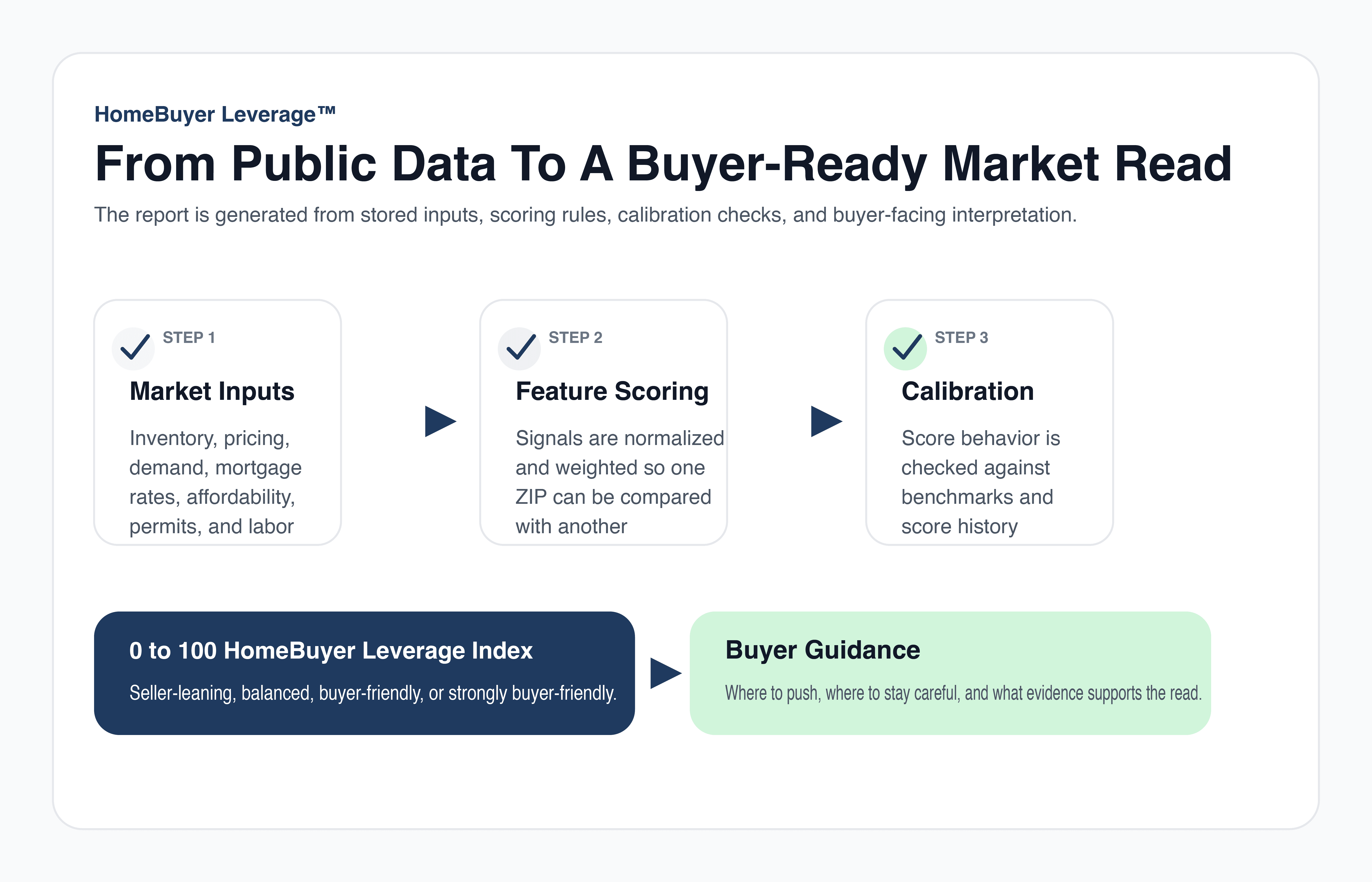
HomeBuyer Leverage is designed to reduce that guesswork. The report turns market signals into a 0 to 100 HomeBuyer Leverage Index, then explains what the score means for a buyer preparing to tour, compare homes, ask for credits, or make an offer.
What The Report Calculates
For each reportable ZIP code, HomeBuyer Leverage can:
- calculate a 0 to 100 buyer leverage score
- show whether the market is seller-leaning, balanced, buyer-friendly, or strongly buyer-friendly
- compare the ZIP with regional or statewide benchmarks when available
- identify which signals support buyers and which still support sellers
- preserve score history so recent and annual shifts can be measured
- turn the data into practical buyer guidance
The goal is not to predict the future price of a home. The goal is to help buyers and buyer agents understand the current negotiating environment before deciding how hard to push.
Why A Generic AI Answer Is Not Enough
A chatbot might say, "Check days on market and price cuts." That is good general advice.
HomeBuyer Leverage goes further. The report incorporates signals such as inventory pressure, days on market, price cuts, sale-to-list behavior, pending demand, affordability, mortgage-rate pressure, seller lock-in pressure, local labor conditions, permits, vacancy, and repeat-sales price growth.
Those inputs are not treated as loose talking points. They are scored, weighted, and compared so the report can show whether a specific ZIP is becoming more buyer-friendly, more seller-friendly, or mixed.
Why Calibration Matters
There are roughly 33,000 ZIP codes in the United States. A useful market signal has to separate them in a consistent way.
HomeBuyer Leverage does not average a few housing statistics and call it a score. The index uses defined feature weights, normalization ranges, market labels, benchmark comparisons, and score history. That calibration layer helps check whether the model is producing coherent reads across many local markets.
This is one of the biggest differences from a general LLM. An AI answer can sound polished without knowing whether its market conclusion is calibrated. HomeBuyer Leverage is built to test the score before turning it into buyer guidance.
What Buyers Can Do With The Score
The report is meant to support practical decisions, not abstract market commentary.
A buyer or buyer agent can use the score to think through:
- whether to push harder on price
- whether seller credits or repairs may be realistic
- whether a listing looks stale or still competitive
- whether nearby ZIPs offer better leverage
- what protections first-time buyers should keep
- what market signals would change the read
The result is a more grounded offer conversation. Buyers can still listen to their agent, review comps, and evaluate the specific property. HomeBuyer Leverage simply adds a ZIP-level market read that generic AI tools do not calculate on their own.
The takeaway
Use a general LLM when you want to understand a real estate concept.
Use HomeBuyer Leverage when you want a ZIP-level market read backed by structured data, calibration checks, score history, and buyer-specific negotiation guidance.
The difference is simple: AI can explain what buyer leverage means. HomeBuyer Leverage is built to measure where buyer leverage is changing.
See what buyer leverage looks like in your ZIP code
Get my free ZIP report
Get My Report